

"Music is nothing but
The Mystery.
Far beyond
directions and thoughts."

THOMAS
Born on June 27, 1960, Thomas listens to a lot of classical music very early, recorded and in concert.
He is fascinated by symphonic works. From the 1970s, he discovers English pop bands and especially enjoys Emerson, Lake and Palmer. He makes drums with detergent barrels, with skins (heads) of plastic bags stretched with thumbtacks. He chooses large knitting needles from his mother as drumsticks and uses a metal spiral from a notebook for the snare drum. With this improvised drum set, he prefers to accompany the music playing in the parties of that time rather than dance. Aged twelve, he attends a Magma concert. The powerful energy, the musical creativity and virtuosity of the drummer Christian Vander hits him, and confirms him in his choice of drumming and composing. Being the sixth child of a family living in a low-income housing project in the southern suburbs of Paris, he has no instrument or space to play it.
He then trains on a friend’s drum kit. That same year, he begins to practice karate. From 12 to 15, with his ears full of the music he discovers in concert (Gentle Giant, Genesis, King Crimson, Yes, Magma, Gong, Zao), he plays drums by himself. He listens, observes gestures, redraws from memory what he heard. Despite his progression on the instrument, he feels that he does not have the abilities to express himself fully.
He begins taking classes with Christian Nicolas. A week later, he recaps and transmits what he has just learned to some of his high school friends. First steps in his teaching experience, which will span the next forty years. At the same time, he plays in various groups whose members are ten years older than he is.
As a reward for graduating from high school, he chooses to be offered his first drum kit, a Pearl, which he installs in a space borrowed by a Youth Club. He enters directly into classical percussion at the Conservatory of Versailles. Sylvio Gualda immediately notices him and takes him under his wing, offering him a place in the class of excellence he had opened for his best elements. He also chooses to offer him private lessons. In December 1979, he enters directly the Dante Agostini school. Six months later, in June 1979, he is awarded the first prize. Thomas completes in three years, between 15 and 18, a course that normally lasts eleven years.
This is for several reasons: his musical culture, his love and gift for music, the excellence of the teachers who trained him, his creativity, his endurance (after the baccalaureate he spends 15 hours a day on the drums), the integration of karate in the gestures of his game.
Between 1977 and 1979 he buys his Gretsch drum set (sold 20 years later to his former companion from the Conservatoire de Versailles, Simon Goubert). This is how he creates his legendary kit.

In 1986, he adds to the back of his set a hand hammered tam, imported from Wuhan, which will open and close each of his recitals.

Thomas is heavily solicited by many bands and orchestras. Notably by the National Jazz Orchestra where André Ceccarelli
in 1989, offers him to take his place.
But Thomas has another project in mind:
to reveal the drums as a soloist.

A breathtaking one-man show
Bass and Drums

An unbelievable
and wonderful symphony
for drums
Drums only
THE ART OF SOLO DRUMS
A Thomas Patris concert, it’s anything but a "demo". It’s a strange moment where you quickly forget the performance to plunge into a reverie, carried away by his haunting drums. A long history unites percussions and beings. Singing and rhythm are linked to our deepest emotions. This is probably why all audiences are captivated by what Thomas Patris tells. In the center of the bare stage, a drum set all haloed by cymbals shines. Total silence. The air gathers like before a downpour or a storm. A gong begins to vibrate: its vibrations pass through the skins of the drums, surf on the cymbals and slowly envelop us. The drums starts to breathe and our breath instinctively agrees with its. All the parts of the instrument dance, sing and shout in turn. Immense and powerful rustling, bursts of voice, flaming of the cymbals. A man, at the center of this symphony, coordinates, directs and channels, tempers. In this storm, one perceives whispers and murmurs. The caressing, feminine voices of the cymbals respond to the violence of the skins.
It is Life that unfolds and returns, blending in with the center of the gong. Center from where it will always be reborn.


"To make my five toms sing,
I tuned them
on a pentatonic scale
(A#, C, D, F, G)
from the lowest to the highest."


"The gong allows me to install
a climate,
vibrating the space,
the listener.
It permanently
resonates
with the impacts
on the heads, the cymbals. "

His one hour masterpiece will accompany him for thirty years. It is an integral part of his life, his muscles, his nerves and his breath. Labyrinthic branches uplift the audience, unveiling an unknown world. Here, virtuosity is at the disposal of a musical drama ingrained with an epic spirit, played with a visionary mastery. Unclassifiable, the whole masterpiece rolls, gushes, flows, condenses and explodes all around the drummer's wild limbs. Poet and acrobat, he bewitches the audience with the controlled elegance of his gestures. The concentration of his closed eyes expresses a deep trance. Most varied sounds spread out into unsettling combinations, pushing back even further the limits of polyrhythms. The cymbals' voices whisper through drums' chthonian textures, or explode like lightning. Low sounds impact the plexus. The entrails vibrate with an organic beating. Submerged by the snare drum's breakers, the heart wanders. Saturated with improbable waves, the air becomes lighter with the gong's ultimate resonance, shifting towards silence. An unknown, meditative silence that applause fears to break.
Hélène PATRIS
Thomas Patris assumes the risk of performing as a soloist!
His deep knowledge of the instrument, his musicality, and his personality allow him to avoid the easy way of drumming.
His vocabulary is certainly composed of elements of jazz, rock, and even traditional drums, but he integrates them into a very original discourse. His masterpiece is captivating.
Daniel Humair
André Ceccarelli was the first person to tell me about Thomas Patris. I quote him : "Marc, I listened to an artist, he is the Stravinsky of drumming, he reinvented the instrument".
I keep admiring him since then. He is a precursor who should be listened to and appreciated by everyone.
Don't miss him !
Marc Chantereau
From a jungle of metal and wood, Thomas Patris creates a personal and strong world.
A must-see and listen to.
Michel Portal

"Controlling
the sound
is controlling
the movement"
A cappella drumming: T.Patris is indeed a drummer (and not a percussionist), yet he stands apart in the world of drummers. He has chosen to bring his polyrhythmic concepts to life. The purity of his technique, expressed in a martial art-like manner, lends perfect transparency to his phrasing and nuances. This performance traces overlapping trajectories, like the stars do. Emerging from simple rhythmic principles, unpredictable branching patterns multiply.
They take us into an astronomical dimension: the spectacle is breathtaking.
François Laizeau


CONCERT FILMED IN 2006


T. Patris, innovative and stunning musician
brings his virtuosity to light.
Le Parisien
Thomas Patris, playing on a spectacular range of eleven cymbals, seven drums and a gong,
a composition/improvisation, places the music in the center of his desires.
Le Monde
Daring,
persisting,
fighting for
what we love,
assuming our choices.
Art is our life.

THOMAS'
COMPOSITIONS
To stop performing in 2007 was a painful decision for me, however, it had the merit of focusing on my lifelong passion: composition.
The latter, in all its variations, deeply animates my musical life.
I have also acquired over the decades the mastery of sound and studio techniques, giving me total autonomy in the realization of my creations.
I am happy to offer you free listening to all my albums.
"Bravo Thomas pour ce formidable et impressionnant travail sur le son. Tu donnes la vie aux machines, tu leur donnes souffle, sang, chair et mouvement. Chaque pièce a sa direction, son identité, tout en gardant la cohérence de l’album. Je trouve dans tes compositions ce qui manque si souvent dans les musiques dites contemporaines : une vraie connaissance du rythme qui, chez toi, est le résultat de tes longues années de batterie et de recherches polyrythmiques. Ton jeu si personnel s’est transmuté dans la machine, comme endossant un exosquelette. Au bout de ce chemin, malgré son absence, c’est ta batterie, Thomas, qui nous a conduit là.
Avec tout mon respect pour ton travail"
François LAIZEAU


2026

H É L È N E ' S C R E A T I O N S

Born in 1957, Hélène begins to take piano lessons at the age of five. Love at first sight! She quickly, on her own, forms a daily bond with the instrument and dreams of becoming a pianist. Between ten and thirteen years old, she feels the urge to compose and for the first time she writes about thirty pieces.
From the age of fourteen, she opens her classical horizon and begins to sing, for pleasure, all the instrumental and vocal parts that she listens to on vinyl by Miles Davis, Herbie Hancock, Chick Corea, Frank Zappa, King Crimson, Emerson Lake and Palmer, Gentle Giant, Mahavishnu Orchestra, Jethro Tull, Yes, Genesis, Weather report, Magma...
This is how she spontaneously develops strong rhythmic and melodic skills, in the manner of the oral tradition of music teaching in India, a country whose art she particularly appreciates.
Hindered after the baccalaureate by her relatives, her artistic vocations could not begin to hatch until 1979, at the age of twenty-two. After a bachelor’s degree in English, a master’s degree in Spanish and teaching in high school for two years, she decides to quit everything and devote herself entirely to the piano.
It is during this period that she meets Thomas Patris, who will become her life partner. They create and work together seven pieces that they play in concert from 1981. In 1985, she has to stop the stage. This repertoire will be reworked, arranged, and recorded in their studio in 2024 under the title "Duorigines".
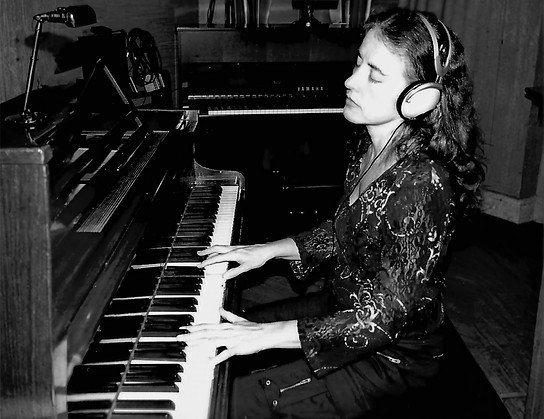
Always driven by the need to express herself, to invent, she also devotes herself to painting and writing poems.
Disadvantaged by a long illness for more than twenty years, she continues however to work her instrument and gives piano lessons between 1990 and 2008.
As a self-taught artist, she also takes up painting again, discovers modelling and sells her creations at exhibitions in Paris in the noughties.

_edited.jpg)


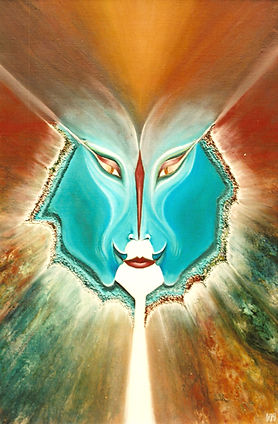

From 2009, Hélène records her compositions
(Piano, Singing, Instrumentals with Logic Pro)
and offers them

DUET
Piano
Drums

Thomas' deep desire for composition is expressed in the band he forms in 1978 and that in the autumn of 1979 the pianist and composer Hélène, who will become his partner, joins.
The band dissolves and it is as a duet piano & drums that Thomas and Hélène propose their compositions in concert in the 80s.
Thomas already presents a 15 minute solo, composed from 1979. He also writes instrumental parts on the first 5 minutes of this piece. Arranged for the piano by Hélène, it will become "Course pour fuite (Run to escape)," played in concert closings.


2024 ALBUM
Hélène and Thomas record in their studio this album before dedicating themselves to their respective compositions.
